
- By data_worker560270f3
- All Tarpaulins
- 0 Comment
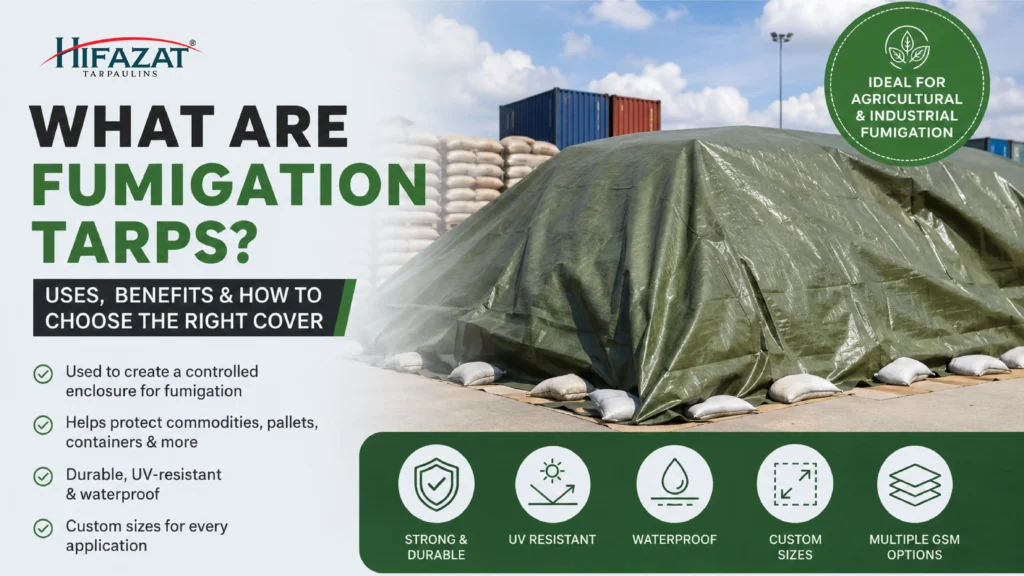
What Are Fumigation Tarps? Uses, Benefits & How to Choose the Right Cover
Fumigation tarps are specialized protective covers used to create a controlled, enclosed space during fumigation treatments. They are commonly used to cover agricultural commodities, stored products, pallets, containers, equipment, and other materials that require pest-control treatment.
Unlike a standard tarpaulin sheet, a fumigation tarp must be selected and installed with the specific requirements of the fumigation process in mind. The cover needs to provide suitable containment, withstand handling and environmental conditions, and allow the treatment area to be properly sealed according to the fumigant manufacturer’s label and applicable safety procedures.
For agricultural, warehousing, logistics, and industrial operations in the UAE, choosing the right fumigation tarpaulin can make a significant difference to the reliability and practicality of a treatment setup.
Quick Answer: What Is a Fumigation Tarp?
A fumigation tarp is a durable covering used to enclose commodities, equipment, structures, or defined treatment areas during a fumigation process. The tarp forms part of the enclosure that helps contain the fumigant within the treatment area.
Fumigation tarps may be used for individual stacks, groups of pallets, stored agricultural products, containers, warehouses, and other suitable applications. The exact fumigation method, fumigant, sealing procedure, exposure period, monitoring requirements, and safety precautions depend on the treatment being carried out and must follow the applicable product label and professional procedures.
Hifazat Tarps manufactures customized tarpaulin solutions for fumigation and other agricultural and industrial applications, with options for different sizes and material specifications.
How Does Tarpaulin Fumigation Work?
In a typical tarpaulin fumigation setup, the material or commodity being treated is enclosed under a suitable cover. The edges of the cover are then sealed sufficiently to create the required treatment enclosure before the fumigant is introduced by trained personnel.
The basic concept is straightforward:
The commodity or material requiring treatment is prepared.
A suitable fumigation tarp is positioned over the treatment area.
The enclosure is sealed according to the fumigation procedure.
The fumigant is introduced by qualified personnel.
The treatment area is monitored according to the applicable requirements.
After the required exposure period, the area is properly ventilated and cleared before normal access.
Professional fumigation requires more than simply placing a tarp over a product. The enclosure, sealing, fumigant concentration, exposure time, monitoring and aeration requirements must all be managed according to the fumigant label and applicable regulations.
Agricultural extension guidance describes tarpaulin fumigation as a method where an infested commodity or structure is covered, the edges are sealed, and fumigant is released within the enclosure.
What Are Fumigation Tarps Used For?
Fumigation tarps can be used in several agricultural, commercial and industrial situations where a suitable enclosed treatment area is required.
1. Agricultural Commodity Fumigation
One of the important applications is the treatment of stored agricultural commodities.
Depending on the approved fumigation method, tarps may be used around products such as:
Grains
Seeds
Pulses
Agricultural produce
Stored commodities
Bagged products
Palletized goods
Tarpaulin fumigation can allow individual stacks or groups of commodities to be treated without necessarily treating an entire warehouse.
2. Warehouse Fumigation
Warehouses storing agricultural or other susceptible products may require pest-control treatments as part of their operational procedures.
A suitable fumigation cover can help create an enclosed treatment area around selected goods or sections of a facility when the fumigation method permits this approach.
This can be particularly useful when specific commodities require treatment while other areas of a facility do not.
3. Container Fumigation
Fumigation is also used in logistics and international trade for certain commodities and shipments.
Depending on the treatment requirements, specialized covers can be used to enclose suitable loads or treatment areas. Container and cargo fumigation must always follow the applicable regulatory, shipping and fumigant requirements.
4. Pest-Control Applications
Fumigation tarps are used to help contain fumigants during certain pest-control treatments.
The purpose of the cover is not simply to protect the material underneath it. Its role is also to form part of a controlled enclosure so that the treatment can be performed according to the required procedure.
5. Industrial Fumigation
Certain industrial materials, equipment, storage areas or facilities may require fumigation or pest-control treatment.
Customized tarpaulin covers can be useful where standard sizes are unsuitable and a larger or specially fabricated enclosure is required.
Why Is the Right Fumigation Cover Important?
The performance of a fumigation setup depends on several factors, including the treatment area, sealing method, condition of the cover, environmental conditions and the specific fumigant being used.
A suitable fumigation tarpaulin can offer several practical advantages.
Better Enclosure
A properly selected and maintained cover helps create the physical enclosure required for the treatment process.
Durability During Handling
Fumigation covers may need to be positioned, removed, folded and reused. A durable material can help withstand repeated handling when properly maintained.
Protection Against Outdoor Conditions
In the UAE, outdoor operations may involve intense sunlight, heat, dust and wind. UV-stabilized and weather-resistant tarpaulin materials can be advantageous for applications exposed to these conditions.
Custom Sizes
Treatment areas do not always have standard dimensions. Custom-made fumigation covers can be produced to suit specific applications, reducing the need to join multiple smaller sheets where a larger single-piece cover is more appropriate.
Reusability
Depending on the material, application, treatment chemicals and condition of the cover, a suitable fumigation tarp may be reusable. Covers should always be inspected for damage before subsequent use.
What Makes a Good Fumigation Tarp?
Not every tarpaulin is automatically suitable for fumigation. The required specification depends on the application and fumigant.
When evaluating a fumigation cover, consider the following factors.
1. Material
The material should be selected according to the intended fumigation application and its compatibility with the treatment process.
Hifazat offers polyethylene-based and ultra-strength tarpaulin solutions for agricultural, industrial, construction and other applications. Its fumigation cap cover page describes heavy-duty polyethylene construction and customized sizing for fumigation requirements.
2. Strength and Tear Resistance
A fumigation tarp may be exposed to pulling, folding, handling and contact with pallets or other materials.
Good tear and puncture resistance can help reduce the risk of damage during installation and removal.
Hifazat’s ultra-strength tarpaulin fabric is designed with tensile, tear and puncture resistance for demanding applications.
3. Waterproofing
Waterproof performance can be important when covers are used outdoors or where protection from moisture is also required.
However, waterproofing alone does not determine whether a tarpaulin is suitable for fumigation.
4. UV Resistance
For fumigation operations in the UAE, prolonged exposure to strong sunlight can affect many outdoor materials over time.
UV-stabilized tarpaulin can provide improved resistance to degradation caused by sunlight. Hifazat states that its tarpaulin fabric is UV treated and designed for long outdoor life.
5. Size and Fabrication
The correct cover should be large enough for the intended application and allow the required sealing arrangement.
Hifazat manufactures customized tarpaulins and large-format covers according to customer requirements, with available film thicknesses ranging across multiple GSM specifications.
6. Seams and Construction
For large fumigation covers, the way individual sections are joined can be important.
Depending on the application, fabricated covers may require appropriately constructed seams, reinforced edges or other fastening arrangements.
7. Condition of the Cover
Before every use, inspect the tarp for:
Tears
Holes
Punctures
Damaged seams
Worn edges
Degraded areas
Damaged fastening points
A damaged cover should not be assumed to be suitable for a fumigation treatment.
Fumigation Tarp vs Standard Tarpaulin: What’s the Difference?
A standard waterproof tarpaulin is primarily designed to protect materials from environmental exposure such as rain, sunlight and dust.
A fumigation tarp, on the other hand, is selected for its role in creating an enclosure for a specific pest-control treatment.
The distinction is important because a tarp that is waterproof or heavy duty is not automatically suitable for every fumigation application.
When choosing a fumigation cover, consider:
The fumigant being used
Required enclosure conditions
Material compatibility
Treatment area
Sealing requirements
Environmental exposure
Cover size
Expected handling
Applicable safety and regulatory requirements
The fumigation procedure should always be designed and carried out by appropriately trained professionals using the fumigant according to its approved label and applicable regulations.
How to Choose the Right Fumigation Tarp in the UAE
If you are sourcing fumigation tarpaulins in the UAE, start by defining the application rather than selecting a tarp based only on price or GSM.
Step 1: Identify What Needs to Be Fumigated
Determine whether the cover is required for:
Agricultural commodities
Pallets
Grain or seed storage
Containers
Warehouse areas
Industrial materials
Equipment
Other approved treatment applications
Step 2: Determine the Required Dimensions
Measure the treatment area carefully and account for the additional material required for the planned sealing arrangement.
For large applications, a customized single-piece cover may be preferable to joining several smaller sheets.
Step 3: Consider the Environment
For outdoor applications in Dubai and other parts of the UAE, consider exposure to:
Strong sunlight
High temperatures
Dust
Wind
Humidity
Occasional rain
UV-stabilized and weather-resistant materials can be valuable where the cover will experience prolonged outdoor exposure.
Step 4: Select the Appropriate Material
The material should be compatible with the intended fumigation process.
Do not select a fumigation tarp solely because it is advertised as waterproof or heavy duty. Confirm its suitability with the manufacturer and fumigation professional for the specific application.
Step 5: Consider GSM and Strength
GSM refers to grams per square metre and is commonly used to describe the weight of tarpaulin fabric.
Higher GSM can generally indicate a heavier material, but GSM alone does not determine overall performance.
Strength, construction, lamination, tear resistance, flexibility, UV stabilization and the intended application should all be considered.
Hifazat offers tarpaulin films in multiple specifications, including 55, 70, 90, 100, 120, 150, 200, 250 and 300 GSM, with customized sizes available.
For more information about how tarpaulin is produced and the factors involved in its construction, read our guide on How Tarpaulin Is Manufactured.
Step 6: Ask About Custom Fabrication
If your treatment area has unusual dimensions, ask whether the manufacturer can produce a custom fumigation cover.
Hifazat provides customized tarpaulin sizes and large-format covers for different industrial and agricultural requirements.
Fumigation Tarps for UAE Agricultural and Industrial Applications
The UAE’s agricultural, logistics, warehousing and industrial sectors can require protective covering solutions that perform reliably in demanding environmental conditions.
For outdoor use, a tarpaulin may need to withstand strong sunlight, heat, dust and repeated handling while maintaining its structural integrity.
Hifazat Tarps, based in Dubai, provides tarpaulin solutions for fumigation as well as packaging, poultry, greenhouse, portable vermibed, construction and civil engineering applications.
This broader application experience can be useful when a project requires a customized protective covering rather than a standard-size tarp.
For agricultural applications, you can also explore our guide on UV-Resistant Tarpaulin for a Greenhouse.
For construction-related applications, see Best PE Tarpaulin Applications in UAE Construction Projects.
Hifazat Fumigation Tarpaulin Solutions
Hifazat Tarps has been supplying tarpaulin solutions since 1979 and provides customized protective covers for agricultural, industrial and other applications.
Its fumigation cover solution is designed for agricultural, industrial and pest-control applications, with features including heavy-duty polyethylene construction, customized sizing, UV resistance and sealing-focused fabrication.
If you are looking for a fumigation cover manufacturer in the UAE, Hifazat can help assess the required dimensions, application and tarpaulin specifications before fabrication.
You can explore the dedicated Hifazat Fumigation Tarpaulin & Cap Cover solution for more information.
For broader requirements, see Hifazat’s Tarpaulin Solutions in UAE, which covers heavy-duty, waterproof, agricultural, construction and industrial tarpaulin applications.
Frequently Asked Questions About Fumigation Tarps
What is a fumigation tarp?
A fumigation tarp is a specialized covering used to enclose a commodity, material, structure or treatment area during an approved fumigation process. It forms part of the enclosure used to contain the fumigant during treatment.
What are fumigation tarps used for?
Fumigation tarps can be used for suitable agricultural commodities, stored products, pallets, containers, warehouses and industrial applications where a covered fumigation treatment is permitted.
Are fumigation tarps waterproof?
Some fumigation tarpaulins are manufactured with waterproof properties. However, waterproofing alone does not determine whether a tarp is appropriate for fumigation. Material suitability and compatibility with the specific fumigant and treatment method must also be considered.
Can fumigation tarps be customized?
Yes. Custom sizing can be useful when the treatment area is larger than standard tarp dimensions or has an unusual shape. Hifazat provides customized tarpaulin sizes and large-format covers.
What GSM is best for fumigation tarpaulins?
There is no single GSM that is best for every fumigation application. The appropriate specification depends on the size, handling requirements, environmental exposure, material properties and treatment method. A manufacturer or qualified fumigation professional should help determine the appropriate specification.
Can a normal PE tarpaulin be used for fumigation?
Not necessarily. A general-purpose PE tarpaulin should not automatically be considered suitable for fumigation. The cover must be appropriate for the intended treatment and compatible with the specific fumigant and procedure.
How long do fumigation tarps last?
Service life depends on the material, UV exposure, frequency of use, handling, storage, chemical exposure and maintenance. Inspect the tarp before every use and replace it if its condition could compromise the intended enclosure.
Where can I buy fumigation tarps in the UAE?
Fumigation tarps can be sourced from specialized tarpaulin manufacturers and suppliers. Hifazat Tarps is based in Dubai and provides customized fumigation covers for agricultural, industrial and pest-control applications.
Final Thoughts
The right fumigation tarp is more than a simple waterproof sheet. It is an important component of a controlled fumigation enclosure and should be selected according to the treatment application, fumigant compatibility, dimensions, environmental conditions, strength and sealing requirements.
For businesses in Dubai and across the UAE, the harsh outdoor environment makes durability, UV resistance and appropriate material selection particularly important.
If you need a custom fumigation tarp, fumigation tarpaulin or fumigation cover, discuss your application and required dimensions with a specialist manufacturer before choosing the material.
Hifazat Tarps provides customized tarpaulin solutions from Dubai for fumigation, agriculture, construction, packaging, poultry and industrial applications.